Great circles and rhumb lines
Get in loser, we’re making loxodromes

- Download this
csvfile by clicking the link: rhumb.csv - Create a new ArcGIS Pro project
- I removed the default basemaps and added a generalized countries layer from Living Atlas (
World_Countries_Generalized) - Open the “XY to line” tool and run the tool twice with the following parameters, changing the “Line type” setting each time:
- Set
rhumb.csvas the input - Start X = “start_lon”
- Start Y = “start_lat”
- End X = “end_lon”
- End Y = “end_lat”
- Line type = first do “Rhumb lines,” then do “Great circles”
- Set
- Add them to the map
- For each feature class, do “Calculate Geometry Attributes”
- Create a new field called
real_length - Give it a type of “Length (geodesic)”
- Length units = “International Nautical Miles” (or whatever you want, I used this unit)
- Coordinate system can stay blank
- Create a new field called
- Tweak the symbology, if necessary. I made lines thicker
- Turn labeling on for each feature class. You might have to fuss with the labels a bit. I used this expression to render features:
- Great circles =
Text($feature.real_length, 'Great circle length: #,###.#### km') - Rhumb lines =
Text($feature.real_length, 'Great circle length: #,###.#### km')
- Great circles =
Now you have two feature classes, each displaying different lengths in kilometers of distance from three cities:
- Boston to London
- Norfolk to the Azores
- Antigua to Cote D’Ivoire
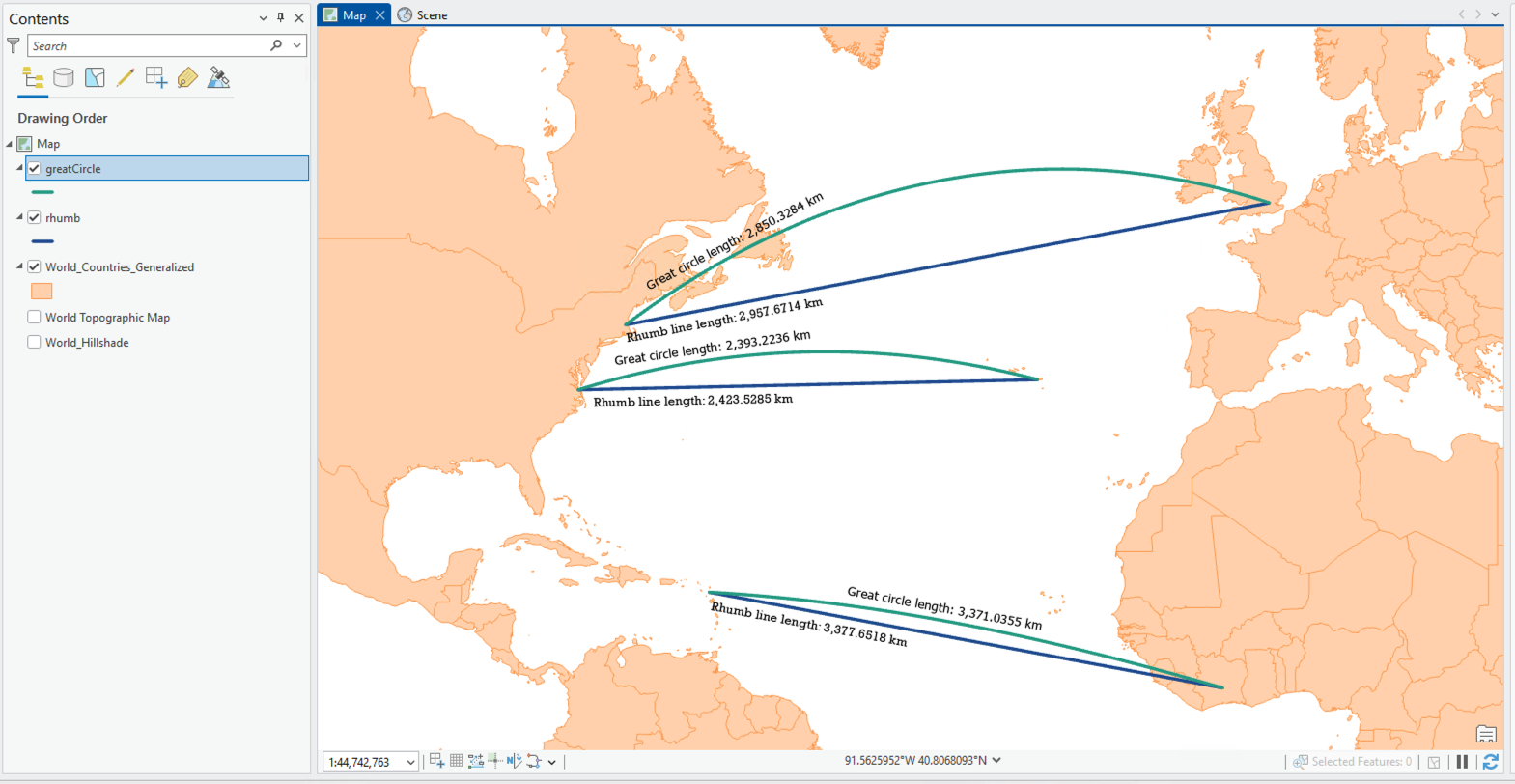
What the heck are these lines?
Here, we’ve got two different ways of calculating distance on the surface of the earth:
- Rhumb lines (or loxodromes) are lines of constant bearing. They cross meridians (vertical lines of longitude) at a constant angle. If we kept . Historically, this is useful for maritime navigation.
- Great circles represent the shortest possible path between two points on the surface of the earth. Ideal plane routes are great circles.
The descriptions below are from a great maritime navigation textbook (Dutton’s):
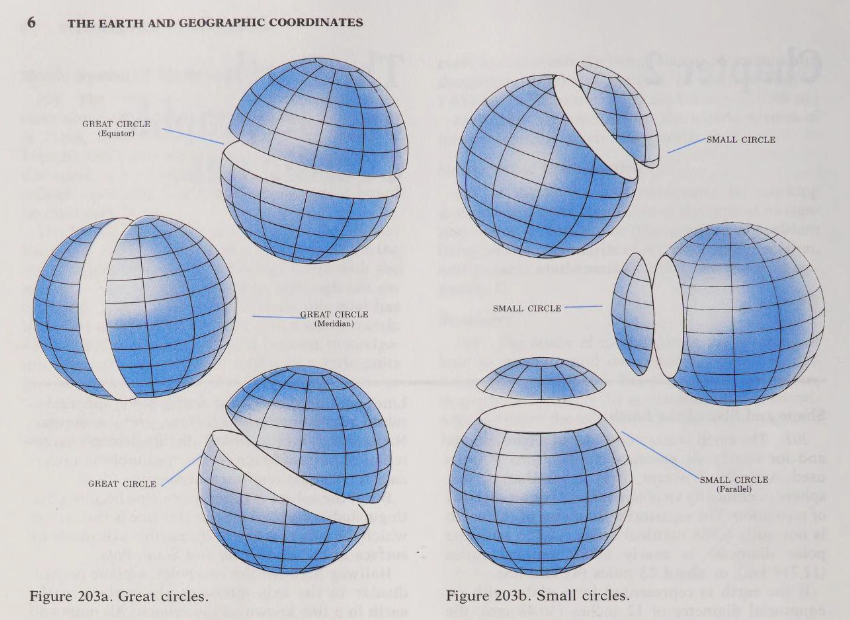
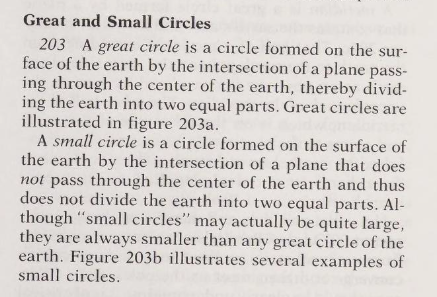
This short blog post has a nice explanation of the difference between great circles and rhumb lines.